

Analysis comes as the Scottish Government admits it "must accelerate" climate action, with new official data showing in Scotland.
- New analysis shows that pollution from Rosebank, if approved, would dwarf the Scottish Government’s already limited efforts to tackle climate change.
- Climate science shows that the world already has more oil and gas than is safe to burn, making new North Sea drilling incompatible with liveable climate limits.
- Campaigners are mounting pressure on the Scottish Government to oppose a super-emitter like Rosebank, as Scotland faces accelerating climate impacts.
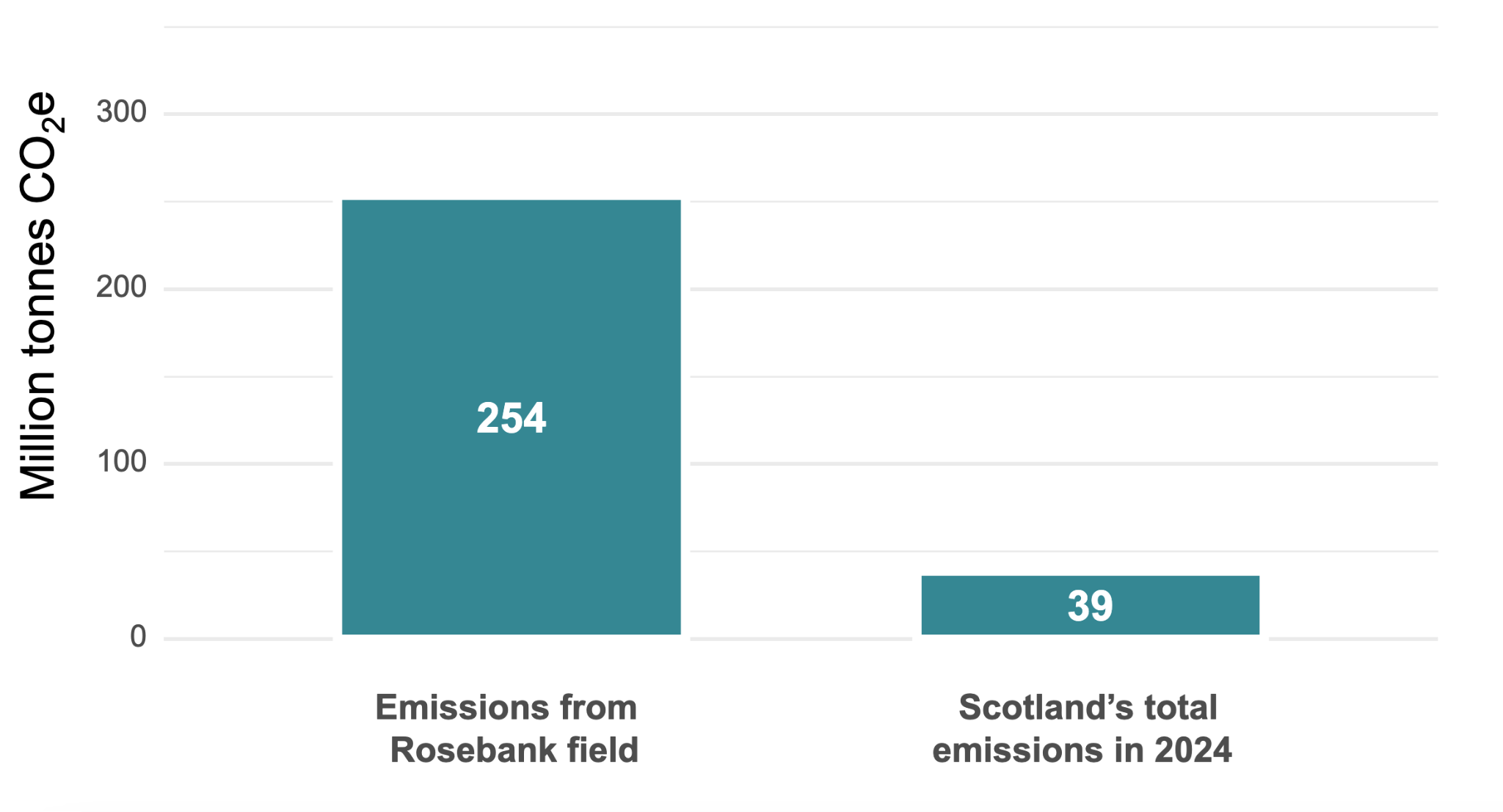
11th June 2025, Edinburgh - The controversial Rosebank oil field would produce six and a half times more climate pollution than Scotland’s annual emissions according to new analysis by Uplift.
The oil project, which has faced years of fierce opposition as the biggest undeveloped oil field in the North Sea, would produce an enormous 254 million tonnes of CO2 equivalent over its lifetime.
The analysis follows the release by the Scottish Government of the latest greenhouse gas emissions data, which puts Scotland’s net total for 2024 at 39 million tonnes. This is just a 1% decline on last year, well below the previous legal targets to cut emissions, and shows that the Scottish Government is not acting fast enough on climate.
In response to the new data, Climate Action Secretary Gillian Martin said work to bring down emissions in Scotland "must accelerate".
Decisions on new drilling – and responsibility for accounting for climate pollution from oil and gas extracted in Scottish waters – rest with Westminster.
However, the Scottish Government’s position remains influential. Its official policy is that new projects must pass a climate compatibility test and take Scotland’s energy needs into account, though recent weeks have seen mixed signals from the SNP on whether it supports further drilling
Campaigners are now putting pressure on the Scottish Government, in light of its slow progress on climate, to oppose the development of a ‘super-emitter’ like Rosebank.
They point to climate science showing that existing global oil and gas reserves already far exceed what can be safely burned in a world committed to limiting warming to 1.5°C, making Rosebank incompatible with climate goals. They also argue that, if approved, Rosebank would continue producing oil beyond 2050, increasing the burden of tackling climate change for future generations.
The escalating impacts of climate change on Scotland were recently set out by the UK Climate Change Committee. Last year, for example, the country experienced early warnings of water scarcity and the most severe wildfire season on record, including the UK's first megafire, which burned for four days across parts of the Highlands and Moray.
Almost entirely oil for export, Rosebank would do nothing to lower bills and would make only a minimal difference to UK energy security. As the head of the International Energy Agency and the world’s leading energy economist, Fatih Birol, recently confirmed, Rosebank “would not change much for the UK’s energy security, nor would [it] change the price of oil and gas”.
Lauren MacDonald, Lead Campaigner at Stop Rosebank said:
“These figures expose the enormous damage a super-emitter like Rosebank would cause. If approved, its emissions would dwarf the Scottish Government’s already limited efforts to tackle climate change.
“It reeks of double standards. While millions of people are worried about the climate crisis, oil giants like Shell and Equinor are seemingly able to pollute on a vast scale and beyond 2050 with impunity.
“The science is clear: the world already has far more oil and gas than can be safely burned. The Scottish Government doesn’t need a ‘climate compatibility’ test to know that Rosebank is fundamentally incompatible with a safe climate.
“Rosebank may be Westminster’s decision, but the Scottish Government must not shirk responsibility for the damage it would cause. Climate change is already driving up food prices and straining water supplies across Scotland, while younger generations face a future of more extreme storms, wildfires and disruption. The Scottish Government must put the public’s need for a safe climate ahead of the profits of multinational oil companies and oppose Rosebank.”
Catrina Randall, Friends of the Earth Scotland just transition campaigner said:
“The Scottish Government needs to stop hiding behind the sham of a so-called climate compatibility checkpoint when challenged about Rosebank and other new fields. It's clear that any climate test that allows new drilling on this scale wouldn’t be worth the paper it's written on.
“Approving new oil would undermine the transition to renewables, locking us further into a rigged system that only benefits greedy fossil fuel companies. Ministers should instead be focused on climate solutions that improve people's lives whilst cutting pollution. This means boosting bus services, repairing homes that are leaking energy to bring down bills and creating secure green jobs in industries with a long term future.”
ENDS
Notes to Editors
Sources
Scottish net emissions for 2024 are official statistics, and were updated in June 2026. Equinor estimated the total lifetime greenhouse gas emissions for the field as part of its submissions to the UK Government following the Scottish Court of Session's January 2025 ruling that Rosebank's original consent was unlawful.